

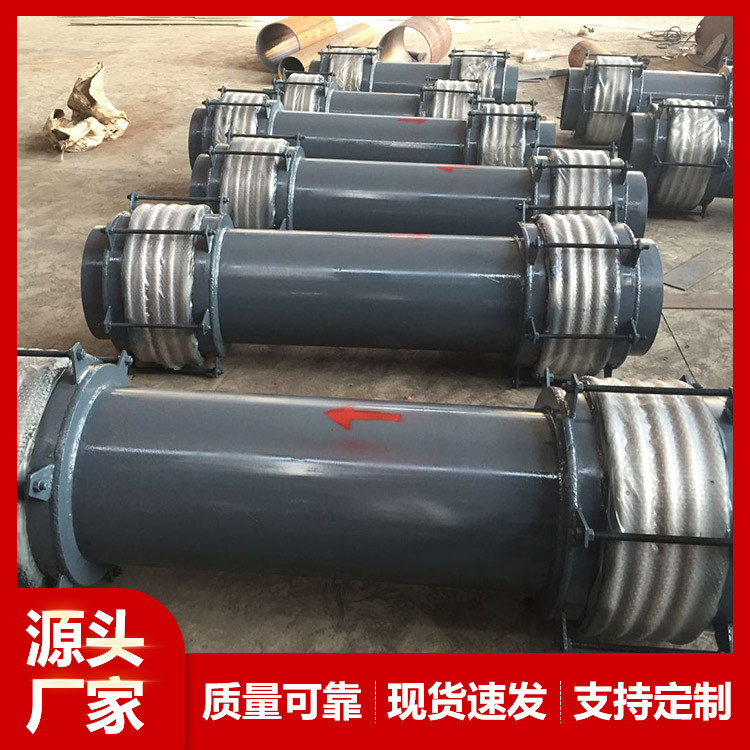














Coal powder pipeline three-dimensional compensator is suitable for coal powder, hot gas solid-liquid two-phase fluid with flow velocity of 15∽30m/s, working temperature of 60℃, and wind pressure ≤500mm for the first, third, and third wind pipeline multidirectional displacement compensation; pipeline system with thermal displacement requirements for gas-solid two-phase fluid containing other solid dust and particles with pressure ≤2.5MPa.
One, examples of coal powder pipeline three-dimensional compensator models:
MSW450×8J/200-L indicates: a three-dimensional compensator for coal powder pipelines, with a nominal diameter of 450mm, 8 waves, a compensating capacity of 200mm, and L representing the product length.
Section 2: Features of the Three-Dimensional Compensation for Coal Powder Pipeline
Withstanding high temperatures, no powder leakage or accumulation, low displacement stiffness; capable of absorbing multidirectional displacement, good flexibility, ensuring free expansion of boilers and piping systems; easy installation and maintenance, simple hangers, long service life. Suitable for 100∽600MW power generation units, it solves the problem of coal powder pipeline leakage and ensures the normal operation of the unit.
Section 3: Three-dimensional compensator material for coal powder pipeline:
The coal powder pipeline compensator is made of 1Cr18Ni9Ti, with the connecting pipe manufactured from low-carbon alloy wear-resistant steel, offering excellent wear resistance.
Section 4: Selection and Installation Requirements for Coal Powder Pipe Three-Dimensional Compensator
1. Coal powder pipeline three-dimensional compensator absorbs displacement: Capable of absorbing axial displacement (X), any lateral displacement (Y) in any direction, axial compensation amount (Xo), and lateral compensation amount (Ymm) to meet the unit requirements. When selecting, the following calculation formula should be met:
2. Large-scale thermal power units with power above 200MW: Vertical displacement of more than 200mm and horizontal displacement of more than 40mm at the interface between the boiler burner and coal powder pipeline. The expansion joint should be as close as possible to the burner installation, and fixed supports should be set up. Isolate the deformation of pipelines beyond the 5th isolation bracket, so that the compensator mainly absorbs the displacement of the boiler. See the following installation method:
1) Horizontally installed near the burner inlet: The vertical displacement of the boiler, and any directional displacement of the boiler and coal powder pipeline, are absorbed mainly through lateral deflection and a small amount of axial displacement by the compensator. To reduce wear and flow resistance, the product is installed in a cold-tight condition (also known as misalignment), with the cold-tight amount being the vertical displacement ΔY at the inlet. This ensures that the compensator can operate in a horizontal state.
2) Vertically installed near the burner inlet: At this point, the compensator absorbs displacement mainly through expansion and a small amount of lateral deflection. To reduce the stress at point A, the compensator is installed in a pre-stretched condition, with the pre-stretch amount calculated as follows:
Note: When ordering products, if the customer requests pre-stretching to be completed by the manufacturer, the supply length of the product will be L + ΔX. If the customer completes it, the lengths of both bellows can be each increased by 1/2ΔX before the product is installed, by using the product's double-end studs (3) and nuts (4).
3) The lateral compensation of the coal powder pipeline compensator is greater than the axial compensation, and the lateral stiffness is less than the axial stiffness. Therefore, under pipeline layout conditions, it is recommended to opt for horizontal installation as much as possible.
4) The constant-force hanger is mainly used to bear the weight of the pipeline and reduce the counter-moment of the compensator deformation. The three-dimensional corrugated compensator has low stiffness and does not experience motion restriction. Therefore, under the aforementioned two installation methods, the constant-force hanger can sometimes be omitted. Whether it can be omitted should be determined by the design department.
5) The coal powder pipeline between the fixed bracket and the blower can be designed with compensators on any horizontal pipe section according to compensation requirements. The weight of the pipeline is supported by rigid hangers or constant-force hangers, and compensators are not allowed to bear the weight of the pipeline.
6) A compensation section (between the furnace and the fixed bracket or bellows) is allowed to have only one compensator; it is not permitted to mix with other types of compensators within the same compensator section.
7) Do not damage or collide the corrugated pipe during installation, hoisting, or construction.
WeChat Official Account

Scan to follow Official Account


















