












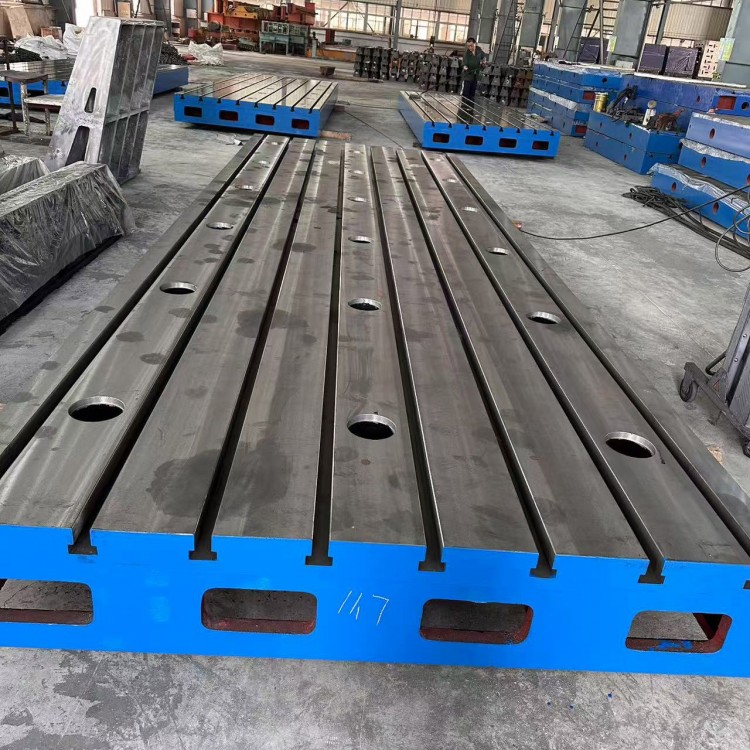


Cast IronVThe type frame is mainly used for the inspection, alignment, and marking of shaft-type workpieces, and can also be used to check the perpendicularity and parallelism of workpieces.
Cast IronVThe material of the frame can be divided into two types: gray iron and spheroidal cast iron.VThe use of type frames is relatively rare, generally employed in smaller specifications and higher precision requirements.VType frame, gray ironVThe type frame is widely used, offering cost reduction, a shorter production cycle, and simple processes. Grey cast iron can also be categorized by its numbering system.VThe frame is an important auxiliary tool in platform measurement.
Cast IronVType frame2One degree of freedom, unrestricted in downward and horizontal (vertical wall) directions, along the groove direction, and three rotational degrees of freedom. Cast ironVThe material of the frame can be divided into two types: cast iron and gray iron.VThe use of type frames is relatively rare; they are generally employed for smaller-sized, high-precision steelwork.VMold frames, such as: grindingVType frame, its precision can be used for0Grade A precision and above steelworkVFrame usage; steelworkVThe use of type frames is quite widespread, facilitating steelworkVThe cost reduction of the frame, short production cycle, and simple process are among the reasons for both manufacturers and users.
Cast IronVThe type frame is used to support cylindrical workpieces such as shafts, pipes, sleeves, etc., to align the workpiece's axis with the working surface for alignment and marking purposes. It is mainly used for inspecting and marking shaft components.
Cast IronVFrame specifications
Cast IronVFrame typeJB/T8047-95Standard Manufacturing, also known asVFrame, commonly used with three holesVType frame, single portVFrame and five-portVType frame.VType frame adopted HT200-250Material, supplied in pairs, primarily used for inspection, marking, alignment, and fixture mounting of shaft components during mechanical processing.
Cast IronVFrame Accuracy: Divided into1Grade2Grade3Grade.
Cast IronVType frames are primarily used to accommodate shafts, sleeves, discs, and other circular workpieces, facilitating the locating of the centerline and marking it out. GenerallyVEach frame consists of two pieces, with the two pieces forming a flat surface.VMold slots are milled in a single installation.VThe parallelism and perpendicularity errors between the surfaces of the frame dimensions.0.01Within millimetersVThe centerline of the mold slot isVThe symmetrical plane of the frame is parallel to the base, and the concentricity and parallelism errors are also0.01Within millimetersVTypical slot semi-angle error is±30~±1Within scope.VType frames can also be marked, with a holding bow frame.VType frame, securely holds cylindrical workpiecesVOn the model frame, flip to the marked positions.
Cast IronVType frames according to mechanical industry standardsJB/T8047-95Manufacturing, material selection Gray Cast IronHT200It is divided into gray iron and ductile iron according to the material.VCast Iron and Gray IronVGray iron, generally cast ironVThe application of cast iron is relatively less compared to gray iron, mostly used for grinding.VCast iron; Gray ironVThe use of cast iron is quite widespread, and gray ironVLow cost for the mold iron, short production cycle, simple process.
VPurpose of the type iron: It is used to support cylindrical workpieces such as shafts, tubes, sleeves, etc., to ensure the axis of the workpiece is parallel to the working surface of this machine, facilitating the alignment and marking tools.
VStandard of wrought iron: As per GB4972-85Standard manufacturing, generally supplied in pairs, it is a tetrahedron with four working surfaces or four different sizes.90Degree slots. Mainly used for inspection and marking of shaft components.
VSpecifications for the cast iron:100×100×80mm 150×150×80mm 200×200×90mm 300×300×120mm.