



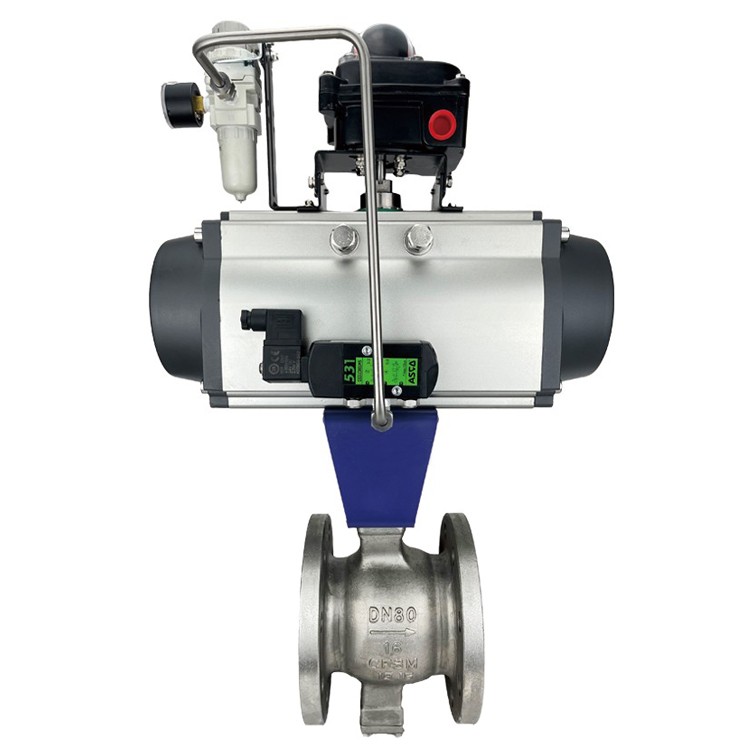















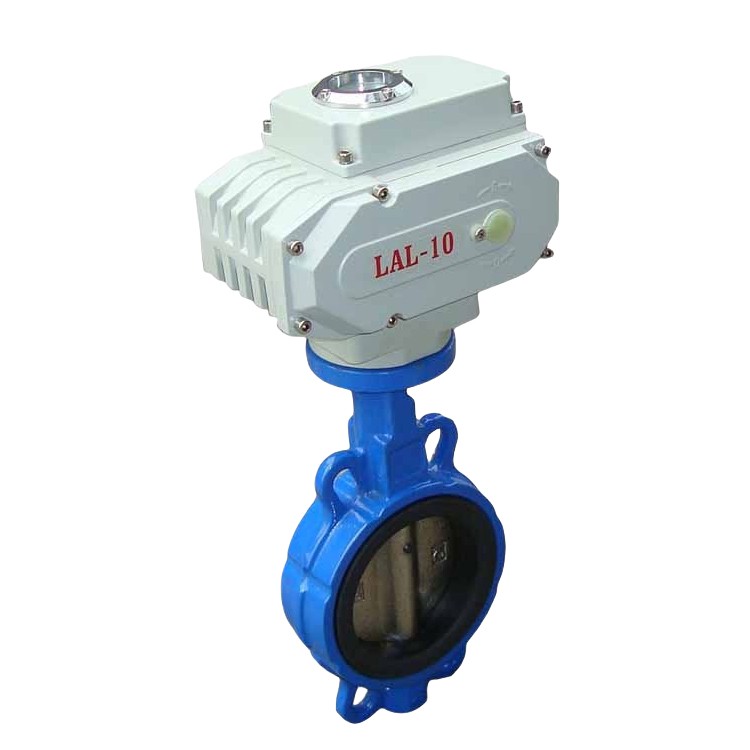
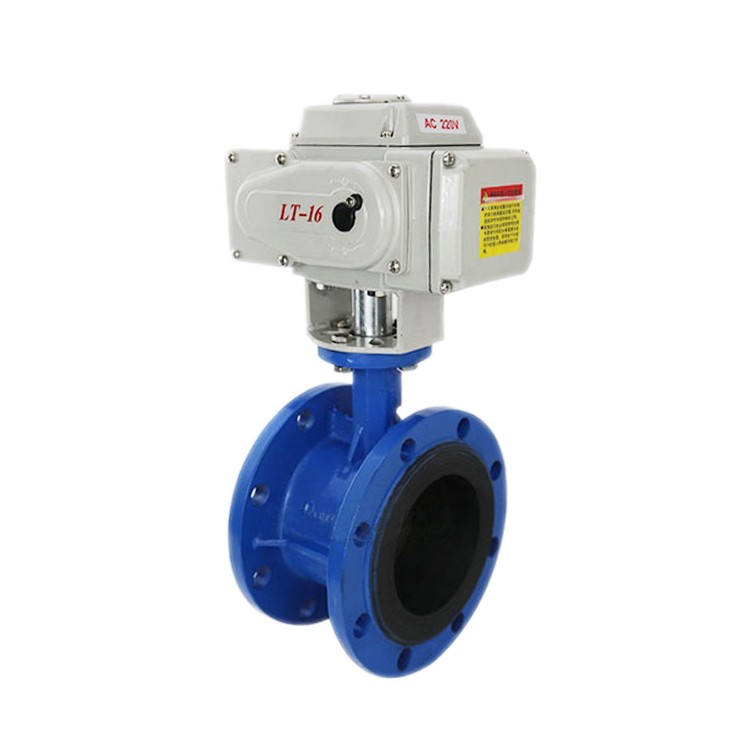
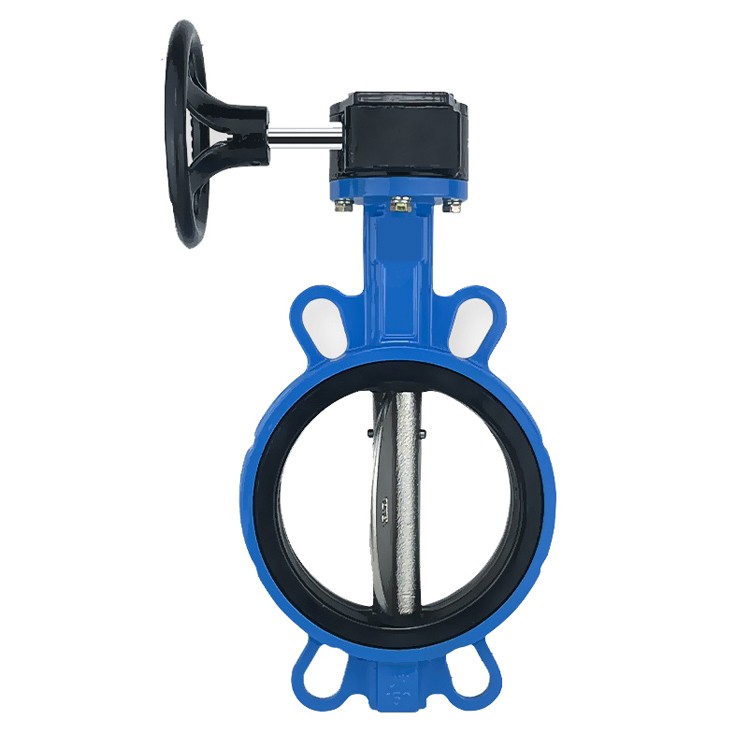

An pneumatic V-ball valve is a valve that combines the features of an pneumatic actuator and a V-ball valve, mainly used for controlling liquids, gases, and steam. It receives control signals through the pneumatic actuator, driving the valve stem and ball to rotate, thereby achieving the flow or cutoff of the medium. The pneumatic V-ball valve boasts advantages such as rapid response, automated control, low fluid resistance, simple structure, and easy operation.
Structural composition
Pneumatic V-ball valves are typically composed of the following main components:
Cylinder: Provides pneumatic power.
Piston: Converts pressure into linear motion.
Valves: Including body, ball, stem, seals, and pneumatic actuators, etc.
Control Valve: Receives control signals and drives the valve action.
Components: Such as flanges, clamp connections, etc., used for connecting and securing valves.
Operating Principle
Upon receiving a control signal, the pneumatic actuator drives the valve stem up and down to rotate the ball within the valve body. When closed, the air pressure pushes the valve stem downward, causing the ball to rotate to the top of the valve seat, blocking the medium flow; when open, the air pressure pushes the valve stem upward, rotating the ball to below the valve seat, allowing the medium to flow.
Features & Advantages
Low fluid resistance: The fluid resistance coefficient of the pneumatic V-ball valve is equal to that of a pipe section of the same length, resulting in minimal resistance when fluid passes through.
Simple structure: Compact and lightweight, easy to operate and maintain.
Sealed Reliability: Utilizes materials like plastic for excellent sealing, ensuring reliable sealing for vacuum systems._
Easy Operation: Quick opening and closing, only requires a 90° rotation from fully open to fully closed, convenient for long-distance control._
Ease of Maintenance: Seals and other moving parts are easy to disassemble and replace.
Wide Range of Application: Suitable for various mediums from small to large diameters, and working conditions from high vacuum to high pressure.
Application Fields
Pneumatic V-ball valves are widely used in various industrial fields, including:
Chemical Industry: Used for control of liquids, gases, and other mediums.
Petroleum Industry: For control of oil, natural gas, and other media.
Food Industry: Materials such as stainless steel are used, meeting food hygiene standards.
Industry: Compliant with industry hygiene requirements._


















