







Product Introduction:
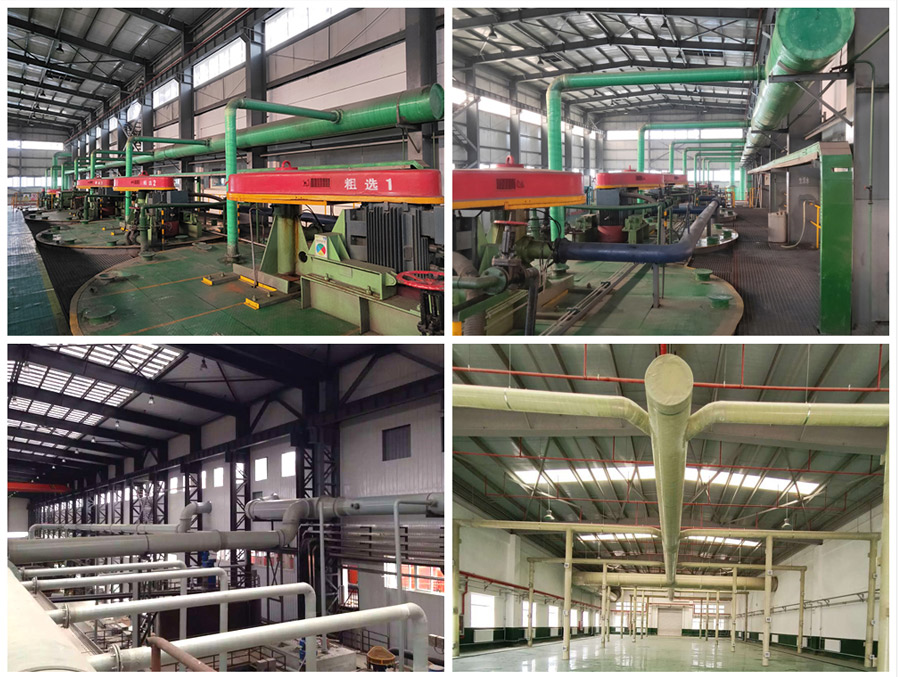
1. Fiberglass Reinforced Plastic (FRP) process pipes are a lightweight, high-strength, corrosion and acid-base resistant non-metallic pipeline. They are based on unsaturated or vinyl ester resins as the matrix, with glass fibers being wound layer by layer on a rotating mandrel according to process requirements. The wall structure is rational, fully utilizing the material's properties. It enhances stiffness while ensuring product stability and reliability without compromising strength. FRP process pipes, known for their excellent chemical resistance, light weight, high strength, non-scaling, strong seismic resistance, longer service life compared to standard steel pipes, lower overall cost, quick installation, and safety, have been widely accepted by users. These pipes are used in industries such as purification towers, chemical workshops, and waste gas treatment. China's FRP pipe production is rapidly developing, with output increasing year by year and applications expanding to more departments.
2. Glass fiber reinforced plastic (GRP) process pipelines are made from resins and glass fibers using special manufacturing techniques. The "significant energy-saving" reputation of the process pipelines is due to their characteristics, such as n≤0.0084, where the smooth inner wall results in minimal pressure loss during fluid transport. Therefore, for the same flow rate, smaller pipe diameters or lower-powered pumps can be used for long-distance transport. Large-diameter pipelines can also reduce installation costs, cut down on insulation costs, eliminate corrosion prevention expenses, and avoid major repair costs, all contributing to "prolonging the lifespan." Under frozen media conditions, the pipelines will not crack.
II. Product Features:
● Corrosion Resistance: In environments with crisscrossing and dense networks, different corrosion-resistant pipelines can be selected according to the medium's requirements.
● Pressure Resistance: Design and manufacture pipes and fittings according to the required pressure of the process. Conduct pressure testing at 1.5 times the required pressure of the process.
● Heat Resistance: Withstanding low temperature down to -70°C and high temperature up to 250°C.
● Excellent insulation properties and can eliminate static electricity after improvement.
● Excellent flammability and improved self-extinguishing, flame-retardant, and non-combustible properties.
Good transparency and can be improved to present in a variety of colors.
● Improved thermal insulation properties and enhanced heat conduction capabilities.