



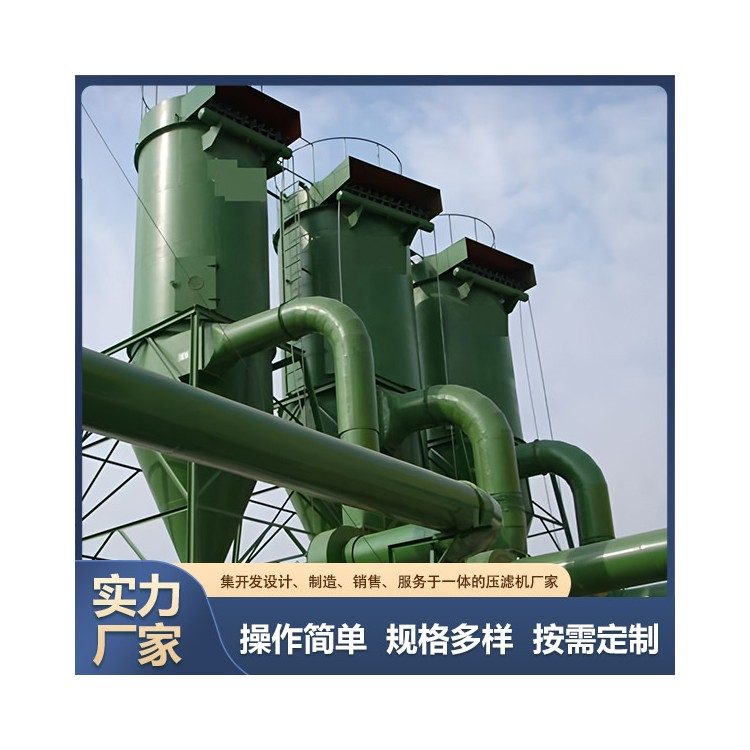














CLK Diffuser Cyclone Dust Collector, also known as a Conical Inverted Cyclone Dust Collector, can prevent secondary dust from being generated by the dust, ensuring high dust removal efficiency. It is suitable for capturing dry, non-fibrous granular dust.
The CLK Cyclone Dust Collector is designed for capturing dry, non-fibrous particulate dust. Its main features include a reverse-conical body, which minimizes the possibility of dust-laden gas short-circuiting from the center of the cylinder to the outlet. It also features a conical reflector screen to prevent the re-entrainment of separated dust by secondary air currents, thus enhancing the dust removal efficiency.
The CLK Diffuser Cyclone Dust Collector is suitable for industries such as metallurgy, foundry, building materials, chemicals, grain, and cement. It captures dry, non-fibrous particulate dust and smoke, and can be used as a material recovery equipment.
The CLK diffuser-type cyclone dust collector features larger conical diffusers replacing the cones of the basic cyclone dust collector. The air-gas separator device isolates the inner and outer vortices. At the bottom of the cone, a truncated cone-shaped reflective screen is installed, thereby reducing the possibility of dust-laden gas short-circuiting from the center of the cylinder to the outlet. The reflective screen prevents the secondary airflow from re-entraining the separated dust and carrying it out with the rising gas, thus enhancing the dust removal efficiency.
Operating Principle:
Dust-laden gas enters the cylinder tangentially through a rectangular inlet, where the dust is thrown against the wall under the action of centrifugal force and follows the rotating airflow downward. Most of the airflow is dispersed by the reflection screen and rises and exits through the exhaust pipe. A small portion of the airflow enters the ash hopper through the annular gap between the reflection screen and the cone, as the diameter of the lower part of the shell increases, the rotating airflow slows down. The dust is collected in the ash hopper due to inertia, while the gas exits through the permeable holes of the reflection screen and then through the exhaust pipe.



















