



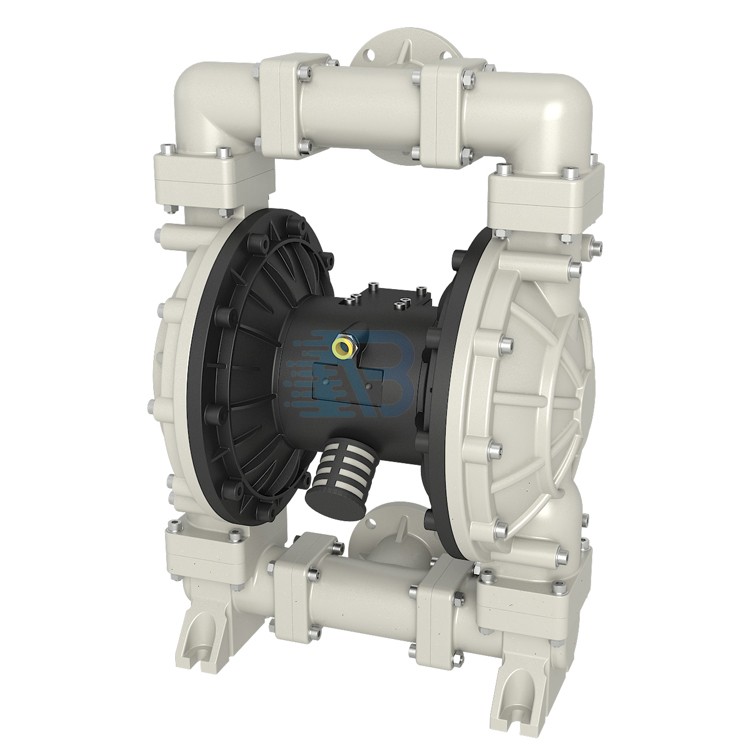














An air-operated diaphragm pump is a new type of conveying machinery powered by compressed air, widely used in various industrial fields, particularly suitable for transporting corrosive liquids, liquids with particles, high viscosity, volatile, flammable, and highly toxic liquids.
Working Principle
The diaphragm pump is driven by compressed air, where high-pressure gas enters the valve chamber and pushes the connecting rod shaft to move back and forth. This movement then drives the diaphragms on both sides to move in the same direction, achieving continuous suction and discharge of the liquid. There are two diaphragms inside the pump, connected by a central rod. When compressed air enters the gas distribution valve, one diaphragm moves outward and the other moves inward, creating the pumping action.
Key Features
Flow Adjustability: Automatically adjusts flow with changes in back pressure (exit resistance), suitable for medium to high viscosity fluids.
High safety: No electrical sparks generated, suitable for flammable and explosive environments, and no heat produced, won't overheat.
Strong self-priming ability: Can run empty without causing danger.
Low shearing force: Minimizes material agitation, suitable for conveying unstable substances.
Wide Application Range: Suitable for a variety of fluids ranging from low to high viscosity, and from corrosive to thick.
Application Fields
Diaphragm pneumatic pumps are widely used in numerous industries, including:
Chemical Industry: Acids, alkalis, solvents, suspensions, etc.
Petroleum Industry: Heavy oil, greases, muds, sludges, etc.
Painting Industry: Resins, solvents, colorants, etc.
Personal Care Industry: Detergents, shampoos, lotions, etc.
Ceramics Industry: Slurry, porcelain paste, etc.
Mining Industry: Coal slurry, magma, etc.
Water Treatment: Lime slurry, wastewater, etc.
Food Industry: Liquid semi-solids, chocolates, syrups, etc.
Beverage Industry: Yeast, syrups, etc.
Papermaking Industry: Adhesives, paints, etc.
Electronics Industry: Solvents, electroplating solutions, etc.
Textile Industry: Dyes and chemical products.
Construction Industry: Cement mortar, ceramic tile adhesives, etc.


















