



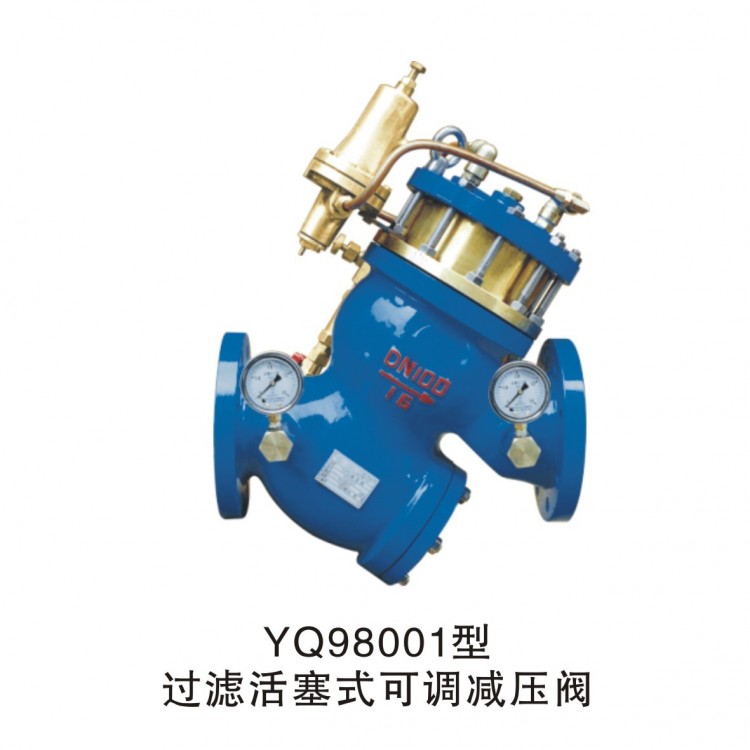















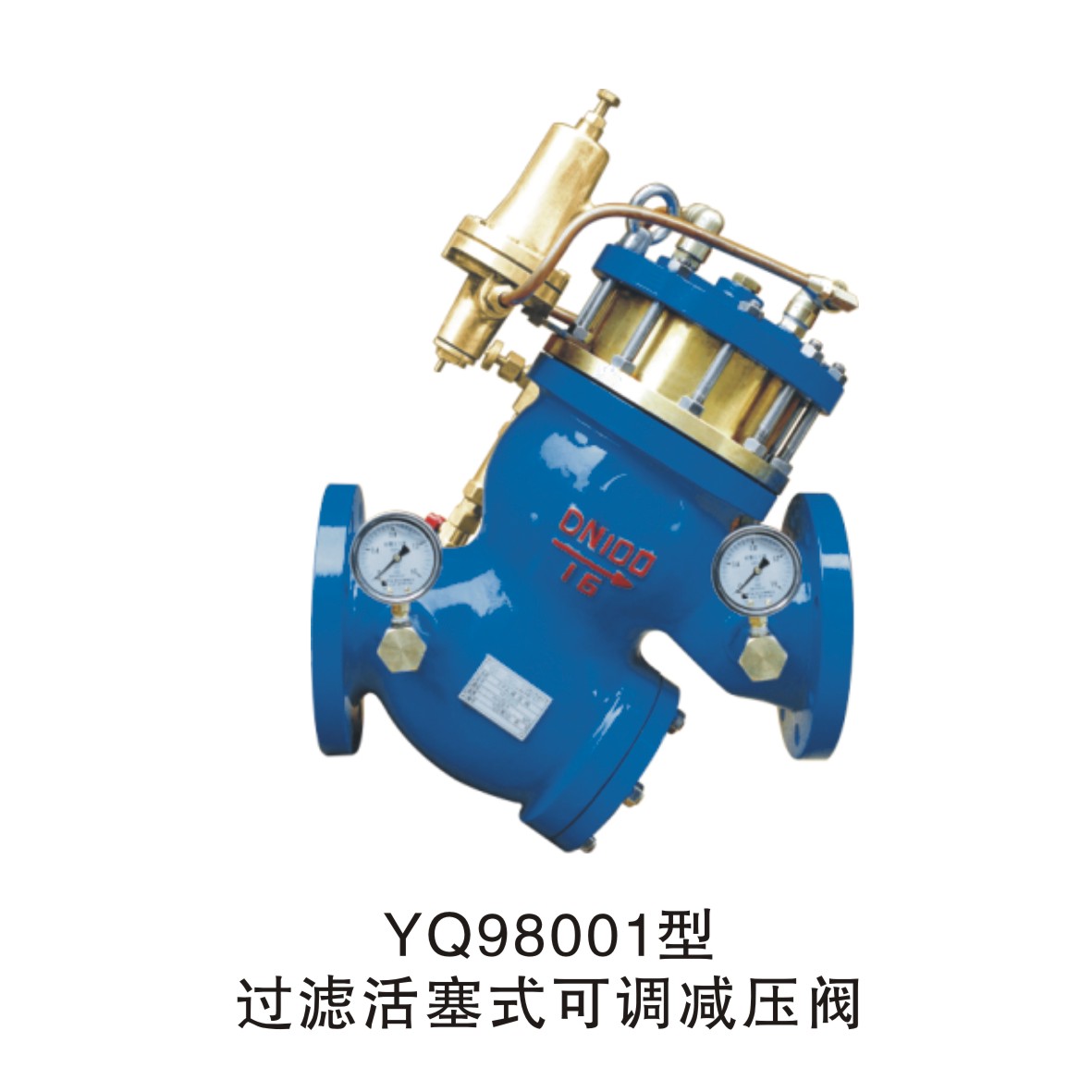
Section 1: Overview of Filtered Piston Pressure Reducing Valve
The upstream pressure enters the upper piston control chamber via a ball valve and control pipe; the upper piston control chamber connects to the downstream through a pressure-reducing control valve and control pipe; the lower piston control chamber is connected to the outlet. By adjusting the pressure-reducing valve's adjusting screw, the downstream pressure can be set. When the upstream pressure and flow rate change, the rise and fall of the sensitive element piston in the pressure-reducing valve controls the main valve's opening, ensuring the downstream pressure remains constant.
This valve is widely used in pipelines in industries such as water supply and drainage, petrochemicals, and power plants, capable of reducing high upstream pressure to the required downstream pressure.
II. Features of Filtered Poppet Relief Valves:
The valve adjustment operation is flexible and convenient, with a wide adjustment range and reliability.
2. Pressure relief effect: The set downstream pressure remains constant regardless of upstream pressure and flow variations.
3. Piston seals are made of dual Y-shaped self-sealing rubber, offering a long service life; piston transmission is smooth and reliable, and can be installed at any angle.
4. Reduces both dynamic and static pressure.
5. Y model wide-body valve cavity, with low flow resistance, strong cavitation resistance, and noiseless operation.
6. Equipped with a built-in filter and vibration-resistant pressure gauge, it reduces the installation length by approximately 40%, minimizing space usage and saving investment costs.
7. Both inner and outer surfaces are coated with an environmentally friendly finish, ensuring product corrosion resistance and safety.
Section 3: Main Technical Parameters and Main Parts Materials of Filtered Poppet Relief Valves:
Nominal Pressure PN (MPa): 1.6 2.5
Nominal Pipe Size DN (mm): 40, 50, 60, 80, 100, 150, 200, 250, 300
Strength Test Pressure (MPa): 2.40, 3.75
Sealing Test Pressure (MPa): 1.76, 2.75
Pressure Relief Range: Generally P1/P2 ≤ 3
Operating Temperature: 0 ~ 100℃
Ambient Temperature: -30℃ to 350℃
Applicable Medium: Water


















