

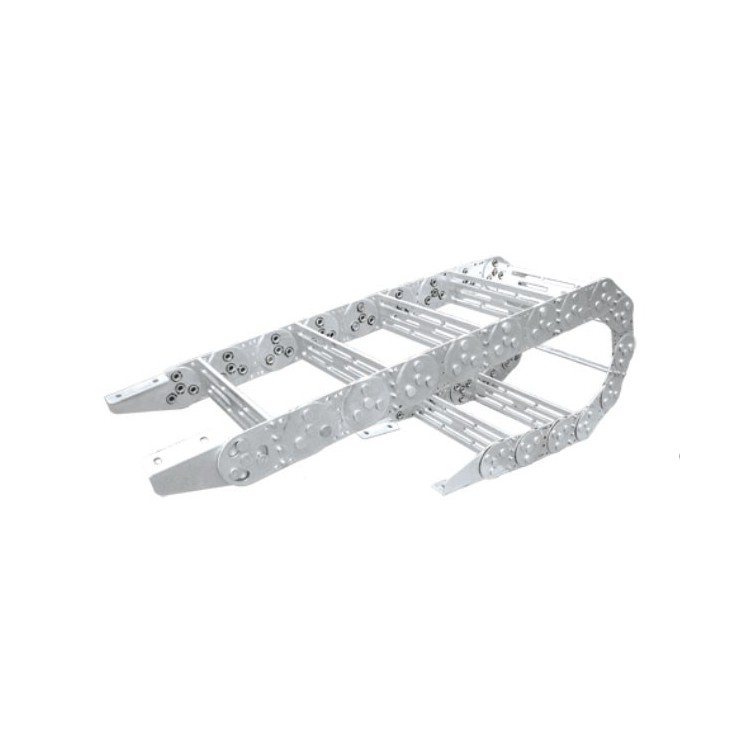















The TL series chain conveyor is composed of components such as chain plates (galvanized steel), support plates (extruded aluminum alloy), and pin shafts (alloy steel), ensuring that there is no relative movement or twisting deformation between the cables or rubber hoses and the conveyor. The chain plates, after zinc-plating, offer a novel appearance and reasonable structure. They feature high flexibility, strength, and rigidity without deformation, easy installation, reliable operation, and are easy to disassemble. Particularly, this product utilizes high-strength, wear-resistant materials, with alloy steel as the pin shafts, enhancing the product's wear resistance. This results in greater flexibility when bending, less resistance, reduced noise, and ensures that the conveyor does not deform or sag over long-term use.
Due to its exquisite appearance, this product greatly enhances the overall artistic beauty of machine tools and equipment, boosting our country's competitiveness in the international machinery and equipment market.
The chain guide is adaptable to high movement speeds of up to 40 meters per minute.
2. The chain guide operates at noise sound pressure levels not exceeding 68 decibels at high-speed movement.
3. Chain-link safety service life is not less than 1 million cycles (reciprocating).


The chain guides are manufactured according to Italian technology.
2. For non-standard bend radii or chainstoppers that deviate from standard designs, please contact us for a separate manufacturing agreement.
3. When the chain exceeds the allowable maximum width Bmax, a composite chain guide made up of three parallel chains can be used. See the illustration below.
Choose the correct chain guide
1. The inner diameter of the support plate cavity, D1, is d + 0.1d (rounded to the nearest integer). Here, d represents the outer diameter of wires, cables, liquid, and gas hoses.
2. Determine the chain plate height hg and the drag chain model TLXX based on the maximum diameter Dmax of the supporting plate cavity.
3. Determine the type of support plate based on the chain guide's functional requirements; chain guide bending radius:
(1) When the chain needs to bear a large load of pipes and cables, an I-type high-strength support plate (solid piece) should be selected.
(2) When the pipe joint size of the piping is larger than the inner diameter of the support plate or frequent disassembly and maintenance is required, Support Type II can be selected. It is a separate type support plate.
(3) When there are many specifications and types of piping to be installed, the Type III support plate (frame type) can be used.
4. Determine the width B1 of the support plate based on the number of installation conduits, from which the chain-link width B can be derived.
5. In cases where the chain is used in environments subject to environmental influence, or when steel belt protective support plates are required, please make a separate request with our company.
Drag chain with three chain plates
Due to the support plate's length ranging from 600mm to 650mm, one or more conveyor chain plates can be installed on wider conveyor chains. Additionally, this design enhances the stability of wider conveyor chains and also isolates the conduit from the cables through the third chain plate.
Note: For GLE type, use parameters D, 12, e; for TL type, use f, j, k.
The elastic condition of hydraulic hoses
Note that hydraulic hoses will elongate or shorten under pressure, so the flexibility coefficient of the hose should be considered, especially under high pressure or when the hose length is long.