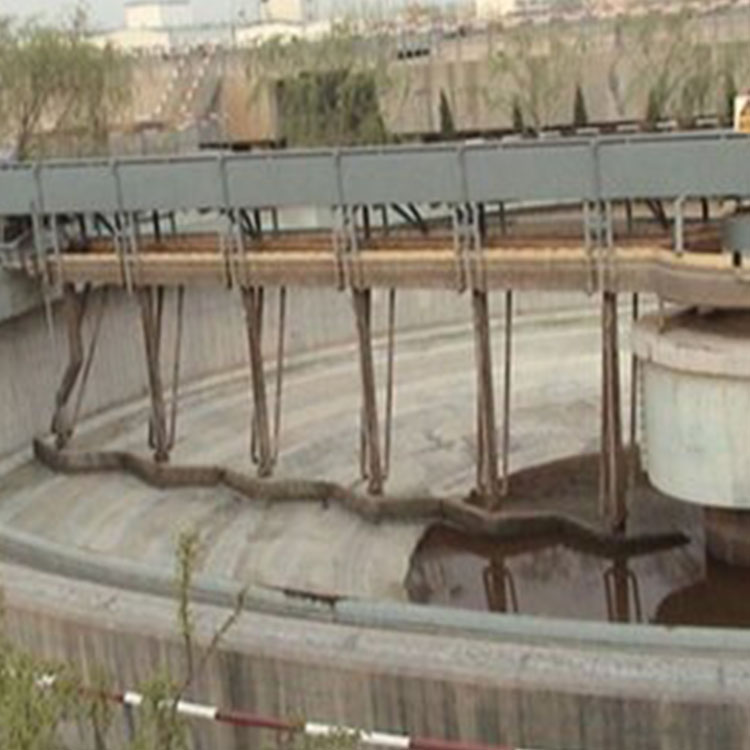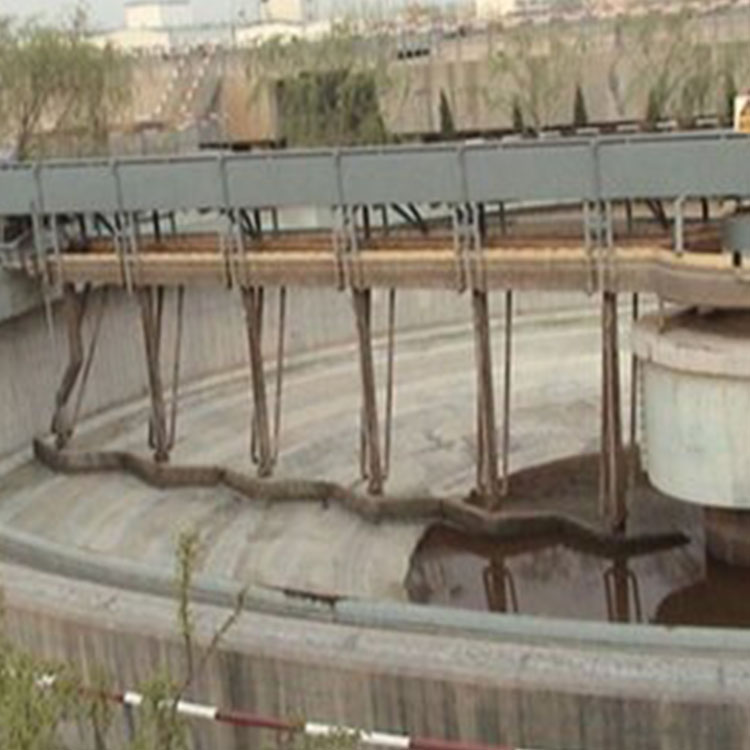










Peripheral drive mud scraper is a scraper with the drive unit located at the edge of the sedimentation pond, usually arranged symmetrically. Therefore, a drive unit set, including an electric motor, reducer, gear set, drive shaft, bearings, and wheels, needs to be set up on both sides of the pond. Types include: Full bridge type, semi-bridge type.
Full-Bridge Type
Composition Structure:
Mainly composed of components such as the working bridge, center bearing, scraper girder, drive unit, flow stabilizing cylinder, skimmer plate, float渣bucket, sludge scraper, and electrical collecting device.
Application Scope:
This equipment is suitable for primary and secondary sedimentation tanks in large sewage treatment plants (typically with flow rates over 600 cubic meters per hour and pond diameters over 20 meters), for scraping and collecting sludge at the bottom of the tanks. Generally, a float渣 (or foam) scraping system is installed at the top, with central inflow, peripheral outflow, and central sludge discharge.
Operating Principle:
Under the power of the drive unit, the scraper truss and mud scraper assembly rotate slowly around the central support, scraping sludge settled at the bottom of the pond towards the central mud collection pit. The sludge in the mud bucket is discharged out of the pond through the pressure difference of the water level within the pond. Meanwhile, the skimming plate removes floating debris into the skimming bucket, which is then automatically flushed out of the pond or drained out naturally.
Bridge Half-Type
Structure:
The complete unit is mainly composed of bridge beams, drive units, upright shafts, underwater bearings, double scraper arms, and mud scrapers.
Operating Principle:
Wastewater from the sedimentation pond flows into the conduit below the working bridge, then evenly distributes across the pond perimeter in a diffused pattern under the umbrella-like cover of the conduit. Sludge settles at the bottom of the pond due to gravity. The scraper rotates slowly under the drive of the scraper arm, separating the supernatant which is then discharged out of the pond through the overflow weir plate. The settled sludge is scraped towards the central sludge collection pit around the pond perimeter by the scraper, and is then discharged out of the pond through the sludge discharge pipe under the force of hydrostatic pressure.
Product Features:
1: Utilizes a hinge-type structure for excellent load-bearing performance
2: Equipped with protective devices, excellent performance
3: Equipped with a shaft-mounted reducer, compact structure