














Product Description:
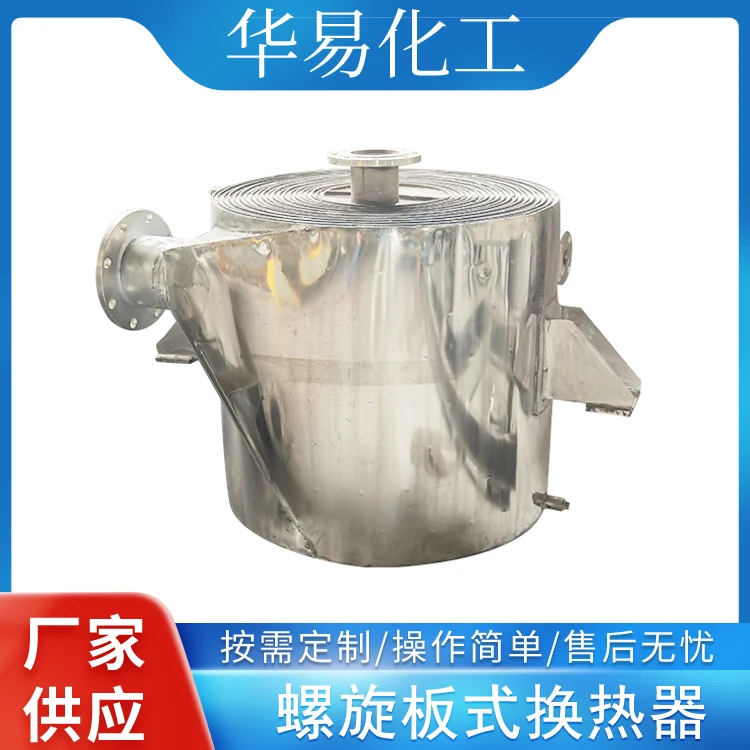
The spiral plate heat exchangers manufactured by Wuxi Huayi Chemical Equipment are highly efficient and energy-saving units designed for complex heat exchange conditions in various industries. With their unique spiral flow channel design and mature manufacturing process, they have become the core heat exchange tools in fields such as chemicals, pharmaceuticals, power, coking, and asphalt processing. The equipment is available in three structural types: non-detachable Type I, one-side removable Type II, and two-side removable Type III, allowing flexible selection based on operational requirements. Their core advantage lies in the formation of a double spiral channel by rolling two metal plates, achieving full counter-current heat exchange between cold and hot fluids. The heat transfer efficiency is improved by 30%-50% compared to traditional tube bundle heat exchangers. Additionally, the high flow velocity and strong turbulent effect within the spiral channels enable self-cleaning, with a scale deposition rate only 1/10 of that in shell-and-tube heat exchangers, significantly extending cleaning cycles and reducing maintenance costs.
In terms of material and performance, the contact medium parts of the equipment can be customized with materials such as carbon steel, 316L stainless steel, Hastelloy, etc., capable of withstanding highly corrosive media like strong acids and alkalis, and high chloride, while also being able to withstand temperatures up to 400°C and pressures of up to 2.5MPa. It is suitable for harsh operating conditions with high viscosity and impurities; its compact structure offers three times the heat transfer area per unit volume compared to traditional equipment, occupying less floor space and meeting installation requirements in space-limited environments. Additionally, Huayi Chemical, with its professional research and production team, supports customized services for channel dimensions and sealing types, and also provides full-cycle after-sales service and technical support to ensure stable operation of the equipment in diverse heat exchange scenarios such as waste heat recovery, medium cooling, and constant temperature control, helping enterprises achieve energy conservation and consumption reduction as well as improved production efficiency.