













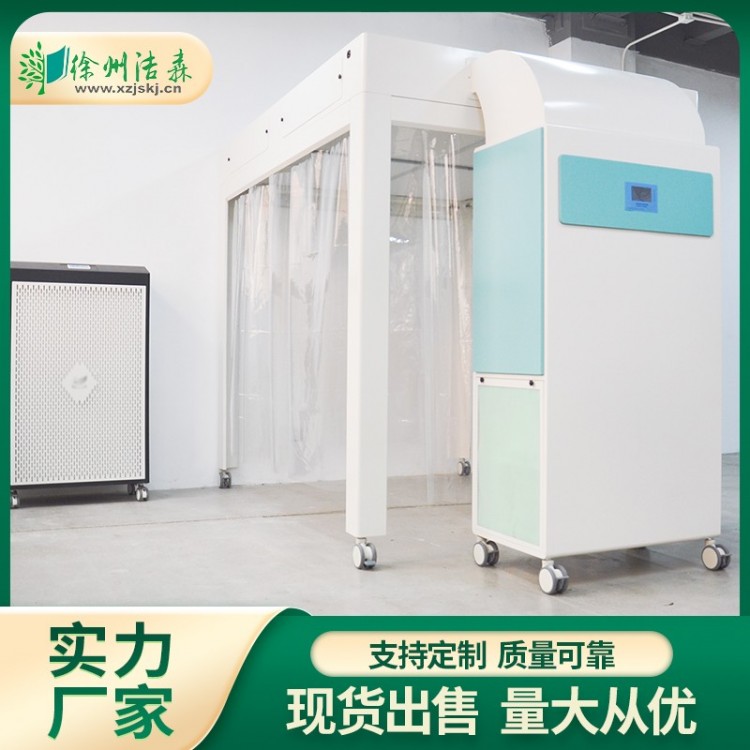


Laminar flow chamber, also known as a cleanroom or "sterile chamber" or "transplant chamber," is a facility that achieves a locally high level of cleanliness through air purification technology. It is widely used to protect immunocompromised patients, such as hematopoietic stem cell transplant recipients and granulocytopenic patients, from external microbial invasion and to control the spread of infectious substances from the patients themselves.
The working principle of a laminar flow warehouse combines aerodynamics with filtration technology. External air is purified through three stages: pre-filter, medium-efficiency filter, and a filter (HEPA/ULPA), before being smoothly and streamline delivered into the warehouse at a constant speed, either horizontally or vertically. This creates an "air curtain barrier" that expels contaminants along with the airflow from the return air outlet, preventing the formation of eddies. At the same time, by maintaining a positive pressure within the warehouse (usually a pressure difference of 5-15Pa), it ensures that air flows unidirectionally from the clean area to the non-clean area, preventing external polluted air from infiltrating.
Based on the air flow direction, cleanroom cabinets can be categorized into vertical and horizontal laminar flow types. Vertical laminar flow cabinets distribute clean air uniformly from the ceiling at the top, passing over the work surface and exiting through the ground intake, suitable for scenarios requiring full area protection; horizontal laminar flow cabinets, on the other hand, create an air barrier through side-to-side supply and exhaust, commonly used for localized operation protection.
The core function of a cleanroom is to maintain indoor air cleanliness at 100,000 to 10,000 class standards, significantly reducing the risk of infection. Clinical data shows that the cleanroom environment can reduce the incidence of infection in hematopoietic stem cell transplant patients by 40% to 60%, significantly improving prognosis. Additionally, cleanrooms offer advantages such as easy installation, quick deployment, convenient mobility, low cost, and small land area, allowing for flexible configuration according to requirements.












