
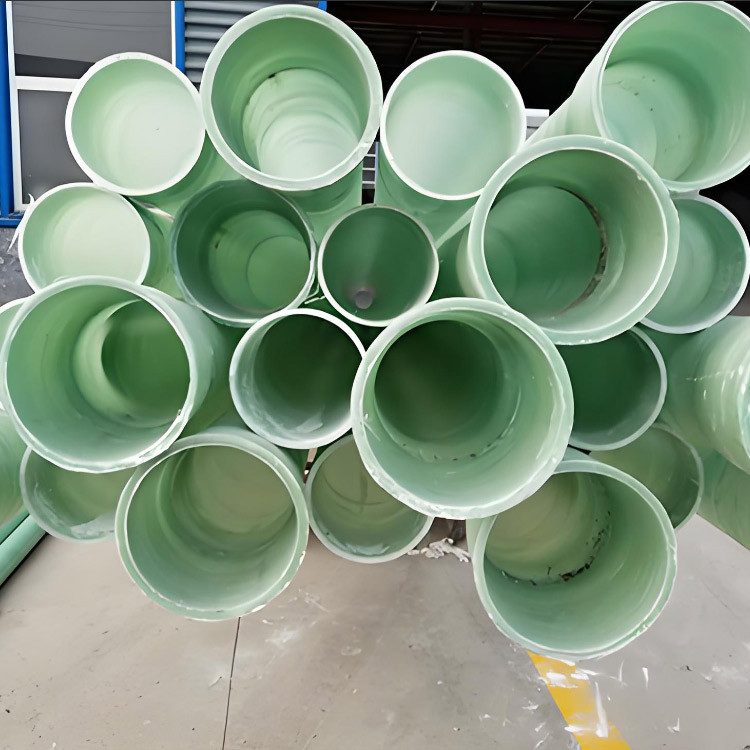









Fiberglass Reinforced Plastic (FRP) Cable Protection Duct — a pipe made with unsaturated polyester resin as the matrix, reinforced with continuous glass fiber and its fabrics, formed through computer-controlled winding or pultrusion processes. FRP Cable Protection Ducts are highly utilized in cable laying, offering clear advantages such as high strength and corrosion resistance, and their smooth inner walls prevent cable damage.
Product Features:
High strength, suitable for direct burial under traffic lanes, no need for concrete protection layer, can accelerate the progress of construction.
Excellent resilience, capable of withstanding external heavy pressure and foundation settlement-induced damage.
Excellent electrical insulation, flame retardant, and heat-resistant properties; can be used at high temperatures up to 130 degrees Celsius without deforming over a long period.
Corrosion-resistant with a long service life, it can withstand the erosion of various corrosive media such as acids, alkalis, salts, and organic solvents, with a lifespan up to 50 years.
The inner wall is smooth, preventing any damage to the cables. The rubber sealing ring facilitates easy installation and connection, and accommodates thermal expansion and contraction.
Low weight, easy to lift by one person, and simple to install by two, significantly reducing the construction period and installation costs. Additionally, it avoids the long exposure of road excavation and its impact on urban traffic order.
Non-electrolytic corrosion, non-magnetic. Unlike steel pipes and other magnetic materials, it does not generate eddy currents that cause the cable to heat up and deteriorate.
Wide Application Range: The FRP cable protection conduit is used for underground cable laying as a protective tube and is also suitable for high-demand situations such as cable crossing bridges, rivers, etc. With the matching professional pipe support set, it can be assembled into a multi-layer, multi-column multi-tube drainage method.
Connection Methods: Glass fiber reinforced plastic cable conduit primarily uses "O" type sealing gasket push-in connection. Special positions may also use flange or adhesive connection methods.
Application Fields: FRP cable protection pipes are suitable for protective conduits for power and communication cables in various environments. Especially when cables pass through key traffic intersections and in special conditions like crossing rivers or bridges, they fully demonstrate their superior performance, such as ease of installation and high strength. They are widely used in infrastructure construction fields including power, communication, transportation, and civil aviation airports.
Structural Features:
(1) Features excellent corrosion resistance; does not require cathodic protection or other anti-corrosion measures, and will not cause secondary pollution to water and other media. The product has a long service life.
(2) Lightweight, the pipe's weight is just 1/4 of the same specification and length of ductile iron pipes and 1/10 of cement pipes. Easy for transportation, loading, and installation.
(3) Longer pipe length per piece reduces pipeline joints, speeds up installation, and improves overall pipeline quality.
(4) The inner wall of the pipe is smooth, reducing flow resistance, increasing flow velocity, and lowering energy consumption. Using a smaller diameter pipe to convey the same volume of fluid can increase the flow rate by about 10% compared to pipes of the same specification; it does not scale and maintains flow velocity over long-term use. It also provides good protection for cables in turbulent and heavily corrosive environments.