














I. Equipment Overview
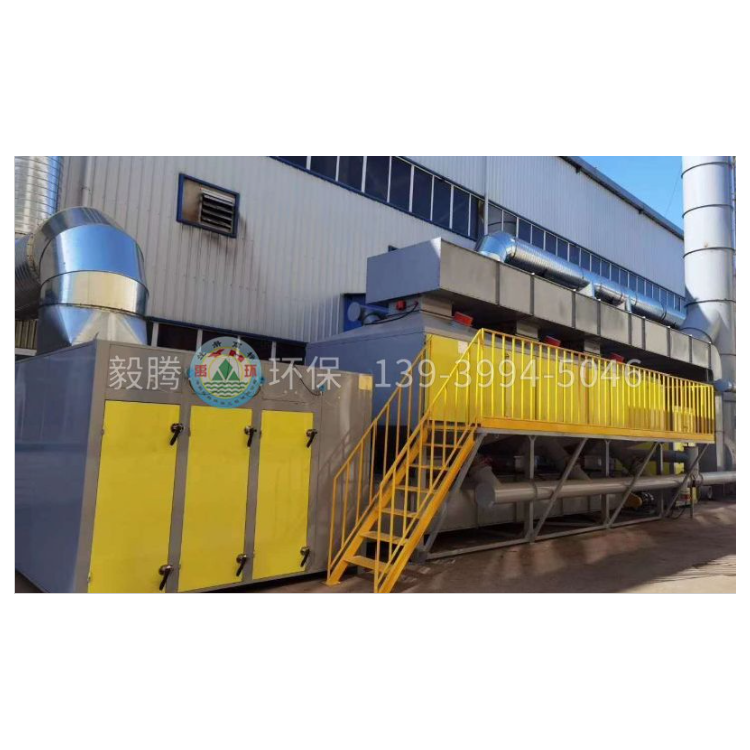
Our Organic Waste Gas Adsorption and Catalytic Integration Unit is a new type of energy-saving and non-secondary pollution waste gas treatment equipment developed based on our years of experience in waste gas treatment. It is mainly suitable for organic waste gases that are not suitable for direct combustion, catalytic combustion, or adsorption recovery methods, especially for high-volume, low-concentration treatment scenarios, where it can achieve satisfactory treatment results.
II. Equipment Usage
Suitable for treating organic waste gases at normal temperatures, with high air volume, medium to low concentration, and high volatility. Capable of processing organic solvents such as benzene, ketones, esters, aldehydes, ethers, alkanes, and their mixed gases.
Section 3: Operating Principle
First, organic waste gases are treated by a dry filter to remove a portion of dust particles. Then, the organic waste gases that meet the adsorption conditions are sent to an activated carbon adsorption box for purification. The purified clean gas is discharged into the atmosphere by the main exhaust fan. The adsorption unit is equipped with a spare adsorption box set. When the activated carbon adsorption is saturated, the control valve switches to the catalytic combustion desorption state. The desorption regeneration system uses on-line desorption regeneration (or off-line desorption regeneration can also be used), meaning the adsorption process is a continuous treatment process. While the spare adsorption unit is in use, the saturated adsorption box carries out desorption work. After desorption, the activated carbon box is ready for the next cycle.
Section 4: Product Features
1. Utilizes a combination of adsorption concentration and catalytic oxidation processes, the entire system achieves a closed-loop purification and desorption process. Compared to recovery-type organic waste gas purification units, it does not require additional energy sources such as compressed air and steam, does not produce secondary pollution during operation, and has low equipment investment and operating costs.
2. The front end utilizes a dry dust filtration system, offering high purification efficiency and ensuring the longevity of the adsorption unit.
3. Utilizing specially molded honeycomb activated carbon as the adsorbent material, the adsorbent has a long service life, the adsorption system has low resistance, and the purification efficiency is high.
4. Utilizing palladium and platinum-plated honeycomb ceramics as catalysts, the catalytic purification achieves satisfactory results. The catalyst has a long service life, low decomposition temperature for waste gas, short desorption preheating time, and low energy consumption.
5. Activated carbon adsorption beds for organic waste gas adsorption, capable of recycling the heat from catalytic combustion for desorption and regeneration. The desorbed gas is then sent to the catalytic combustion chamber for purification. When the organic waste gas concentration reaches above 2000 PPM, it can sustain self-ignition. No external energy is required, with low operation costs and significant energy-saving effects.
6. Utilizing a centralized microcomputer control system, the equipment operates and the operation process is fully automated, ensuring stable and reliable performance.
7. Comprehensive safety facilities are in place, including safety fire valves between gas sources and equipment, strict control of desorption temperature into the activated carbon bed during desorption, fire arrester, temperature sensor rods, explosion-proof openings, alarms, and automatic shutdown measures.
Main Technical Parameters of the Catalyst Bed
Description
1. The inner lining of the catalyst bed is made of stainless steel, while the outer shell is made of carbon steel.
2. Insulation material uses alumina-silicate refractory fiber.
3. Equipment dimensions are subject to the actual measurements.
Key Technical Parameters of Activated Carbon Adsorption Beds
Description:
1. The adsorption material uses honeycomb activated carbon.
2. Equipment dimensions are subject to actual measurements.
Main Technical Parameters of Bag Filters
Activated Carbon Adsorption + Catalytic Oxidation (CO) Technology
I. Overview
Utilizing a combination of honeycomb activated carbon adsorption and catalytic oxidation processes, the entire system achieves a sealed and circulated purification and desorption process. This technology is suitable for treating organic waste gases with low concentrations that are not suitable for direct combustion or catalytic combustion methods, and those that do not require adsorption and concentration recovery. Particularly for high-volume treatment scenarios, it delivers satisfactory treatment results.
Compared to recycling-type organic waste gas purification units, there's no need for additional energy sources like compressed air and steam, nor do you require additional equipment such as cooling towers. The operation doesn't generate secondary pollution, and the equipment investment and operational costs are low.
TwoTechnical Principle
Activated carbon adsorption + catalytic oxidation (CO) technology utilizes a combination of activated carbon adsorption, thermal air desorption, and catalytic oxidation to purify organic waste gases. The technology takes advantage of the multi-micro-porous structure and high surface tension of activated carbon to adsorb organic solvents from the waste gases, thereby purifying the emitted gases in the first process. Once the activated carbon is saturated, the adsorbed organic solvents are desorbed using thermal air at a certain concentration ratio and sent to the catalytic combustion bed in the second process. The high-concentration organic waste gases entering the catalytic combustion bed are further heated and, under the action of a catalyst, the oxygen is decomposed into CO2 and H2O. The heat released during decomposition is recovered by a heat exchanger and used to preheat the high-concentration organic waste gases entering the catalytic combustion bed in the third process. After a certain period of operation, these three processes reach a self-balancing state, and desorption and catalytic oxidation decomposition do not require external energy heating.
Based on the emission volume of organic waste VOCs, two or more adsorption beds can be alternately switched for adsorption use. This way, the continuous operation of multiple adsorption beds can achieve high-volume continuous purification.