

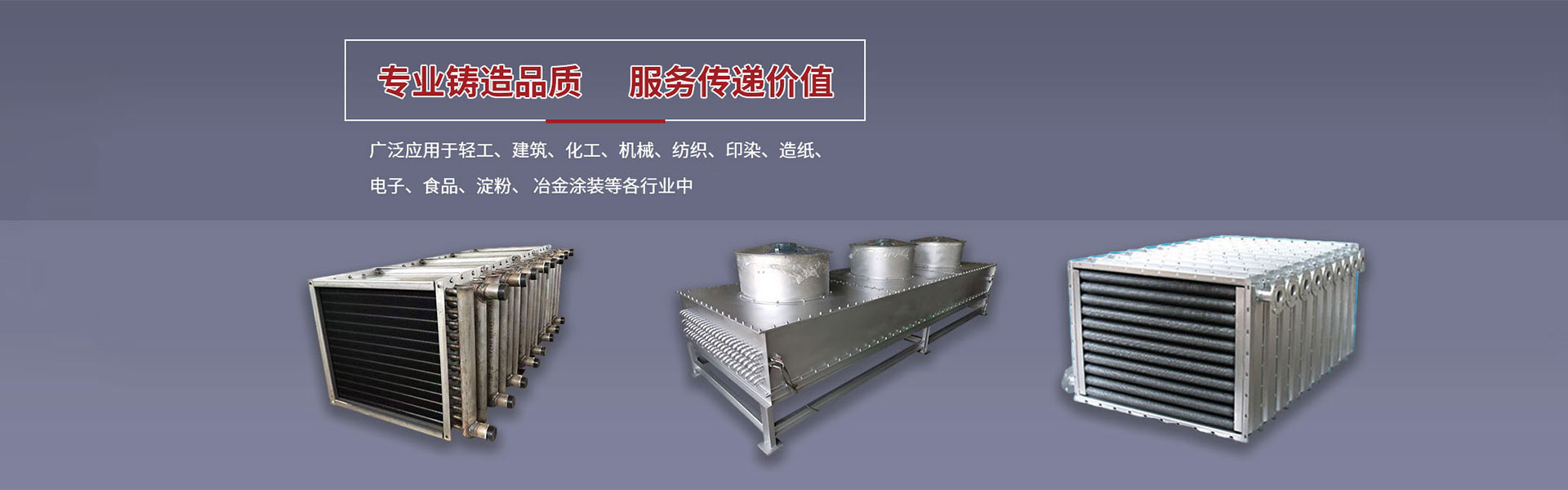


Finned tubeShell and tube heat exchangers are among the earliest and most successful discoveries in the process of improving tubular heat exchangers. This method is still widely used in all sorts of heat transfer enhancement techniques for tubular heat exchange surfaces. It is not only extensively applicable to single fin tube heat exchangers in power, chemical, petrochemical, air conditioning, and refrigeration engineering.
The basic heat transfer element of the finned-tube heat exchanger is the finned tube, which is composed of a base tube and fins. The base tube is typically a round tube, but it can also be elliptical or flat.
The surface structure of the fins includes flat fins, intermittent fins, wavy fins, and perforated fins. Among them, the last two are heat exchange fin types.
Fin-tube heat exchangers are widely used in power, chemical, petrochemical, air conditioning, and refrigeration engineering, such as surface air used in air conditioning engineering.CoolerAir heaters, fan coils. Evaporators used in refrigeration engineering such as cold air blowers and frost-free refrigerator evaporators, which are not only suitable for single-phase fluid flow but also hold significant value for phase change heat transfer.
Most finned tube heat exchangers used for clean gases employ a new fin surface structure, achieving significant enhancement in heat transfer efficiency.

