


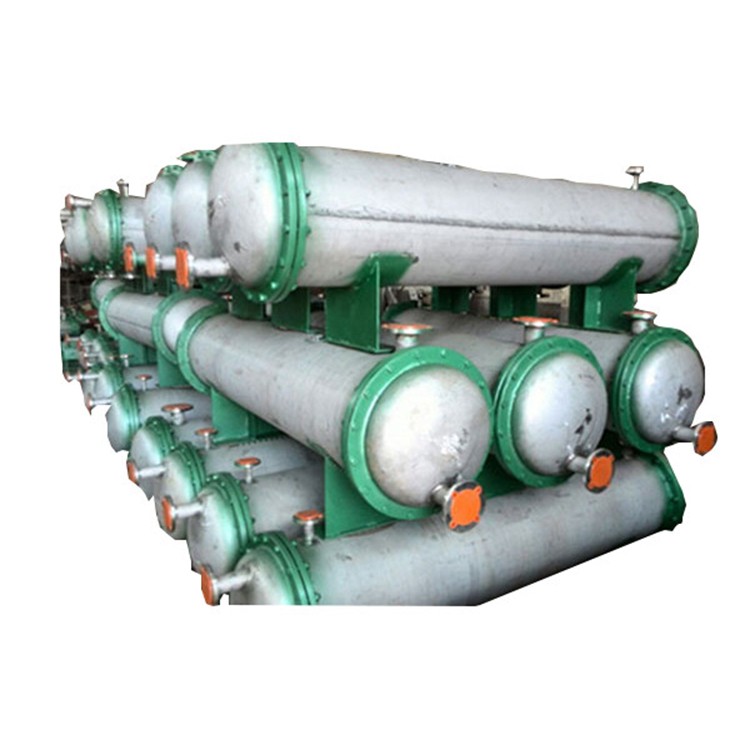

Shell and tube heat exchangerShell and Tube Heat Exchanger, also known asShell and Tube Heat ExchangerA shell-and-tube heat exchanger where the wall of the enclosed tubes serves as the heat transfer surface. This type of exchanger is simple in structure, cost-effective, has a wider flow cross-section, and is easy to clean scale; however, it has a low heat transfer coefficient and occupies a large area. It can be manufactured from various structural materials, primarily metals, and can be used under high temperature and pressure conditions, making it a widely used type.
Shell-and-tube heat exchangers consist of a shell, a bundle of heat transfer tubes, tube plates, baffle plates (shutters), and a tube box. The shell is typically cylindrical, housing the tube bundle with its ends fixed to the tube plates. The two fluids, one cold and one hot, involved in the heat exchange process flow inside and outside the tubes, respectively. Known as the tube-side fluid and the shell-side fluid, they circulate within and around the tube bundle. To enhance the heat transfer coefficient of the fluid outside the tubes, baffles are commonly installed inside the shell. These baffles increase the velocity of the shell-side fluid, forcing it to traverse the tube bundle multiple times horizontally, thereby enhancing turbulence. The heat exchange tubes can be arranged on the tube plates in an equilateral triangular or square pattern. The equilateral triangular arrangement is more compact and results in higher turbulence and a greater heat transfer coefficient for the fluid outside the tubes. The square arrangement is easier to clean and is suitable for fluids that tend to scale.

