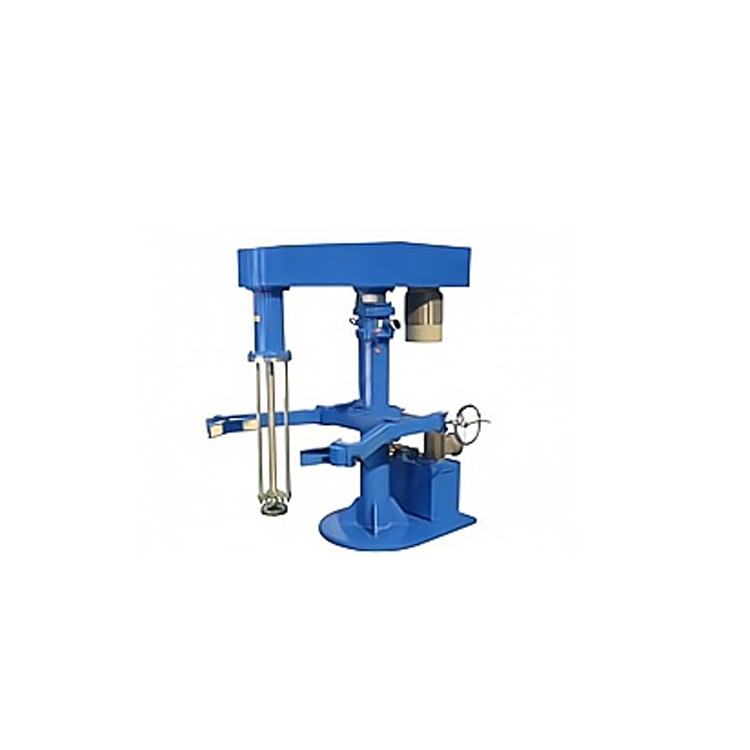

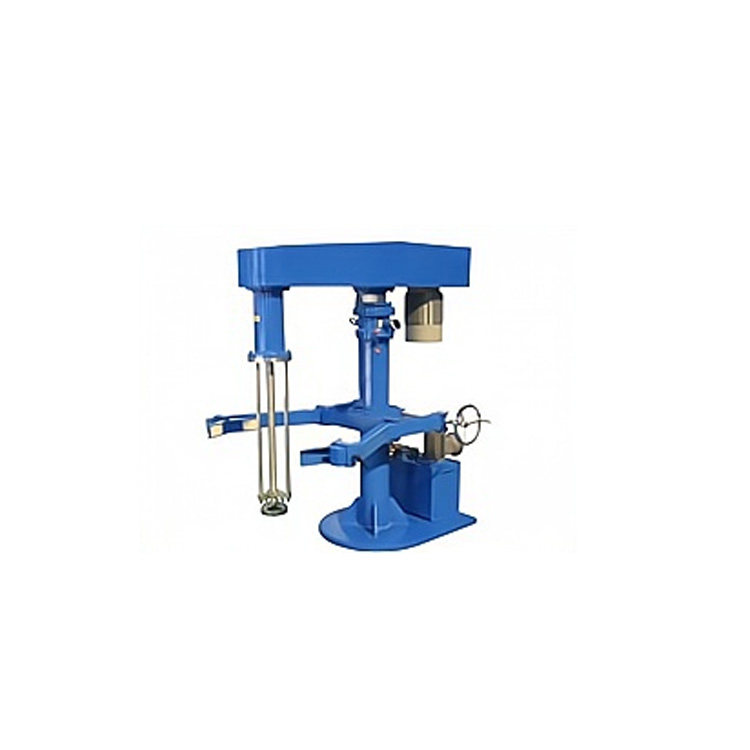








Equipment Introduction:
The high-speed rotation of the rotor creates a pressure drop between the rotor and stator, drawing the material into the rotating and stationary rotors. The high linear velocity of the rotor causes the material to undergo intense shearing, centrifugal extrusion, impact crushing, liquid layer friction, and turbulent mixing before being ejected. Under the influence of various directional forces, a strong turbulent flow is generated. The material is repeatedly circulated, disassembled, dispersed, homogenized, refined, and sheared between the rotating and stationary rotors. Particularly suitable for the preparation of stable emulsions and homogeneous slurries.
There are various types of rotors and installation methods, designed to match different operating conditions.
This equipment is equipped with a hydraulic lifting system, which uses cylinders as actuators to enable the emulsifier to lift and lower vertically.

Operating Principle:
Fill the mixing tank with sufficient liquid, start the motor, and its shaft drives the turbine to rotate. At this point, the stator inlet forms a suction force to draw the material into the homogenizer head. The material is subjected to high-speed impacts, compression, shearing, and friction within the homogenizer head. As it passes through the stator's special holes and is jetted horizontally, the material experiences a second round of high-speed impacts, compression, and shearing. The horizontally jetted material within the homogenization tank generates radial flow and axial movement, resulting in a third impact. The high-shear homogenizer emulsifier, due to the mutual impact and movement of the two streams, as well as the cross-mixing and shearing with the radial flow, creates randomly swirling vortices within the mixing tank.
Unlike traditional mixing theories, it operates at a higher speed with smaller impellers. Designed with the new concept of small impellers and high speed, the impeller diameter is only 1/10 to 1/75 of the mixing tank diameter. The high-shear homogenizing emulsifier, in addition to general convection, also features impact, compression, shearing, and friction. The precise matching of the rotor and stator ensures that the material undergoes several hundred thousand shearing actions per minute. Therefore, it can quickly reduce the particles in the material to sub-micron fineness in a short period of time.

Common Processes:
By applying mechanical external force, narrow the particle size of liquid-liquid and solid-liquid material particles, uniformly distribute one phase into another or multiple phases, achieving refined homogenization, dispersion, and emulsification effects, thereby forming a stable emulsion state.
The high-shear homogenizing emulsifier has a wide range of applications, suitable for mixing, dispersing, emulsifying, homogenizing, deaggregating, suspending, crushing, and dissolving.
Emulsification: The process of preparing a stable emulsion from immiscible liquids.
Homogeneity: A process of further disaggregating, refining, and evening out the dispersed phases in a dispersive system material.
Dispersed: Paste for preparing solid-liquid dispersion systems, consisting of insoluble solid powder or dispersed in a liquid.
Solubility: Solution prepared by dissolving a solid or liquid in another liquid
Mixed: Uniformly blending various dispersed systems to prepare a new material
Application Products:
Biological products, food, pesticides, cosmetics, coatings, paints, inks, pigments, resins, adhesives, slurries, pulp, electronics, battery pastes, nano-modified coatings, biodiesel, coating slurries, extrusion slurries, molding slurries, textile auxiliaries, printing slurries, fruit and jam juices, soup bases, dairy products, tissue homogenates, oilfield chemicals, surfactants, asphalt, emulsifiers, food and beverages, biodiesel, lipsticks, lipsticks, creams, suspensions, syrups.
Component Parts:
Drive motors, bearings and seals, rotating stator working parts, hydraulic lifting systems, control systems, brackets, and other auxiliary components
Whole machine functions optional:
Bottle Capacity: 200L-10,000L
Power Range: 2.2KW-200KW
Power Source: 380/400/415/440/480V; 50/60Hz; 3P
Motor Types: Standard, Explosion-proof, Variable Frequency
Energy Efficiency Rating: GB2 (IE3), GB3 (IE2)
Protection Ratings: IP54, IP55, IP65
Speed Control Method: Variable Frequency Speed Control, recommend using imported brand variable frequency inverters.
Lifting Mechanism: Hydraulic Lift
Rotor: High shear, cutoff, up-spray, etc., with a total of 10 standard rotor types available, as well as customized rotor options.
Work Environment: Atmospheric, Vacuum, Positive Pressure
Sealing Method: Skeleton Oil Seal, Mechanical Seal
Cap: Standard Swing Lid, Sealed Vacuum Lid, No Lid
Container Jacket: No Jacket, Full Jacket, Spiral Jacket
Heating Methods: Non-Heating, Electric Heating, Steam Heating, Heat Transfer Medium Circulation Heating
Container Fixation: Manual Fixation, Automatic Fixation
Material: 304, 316L, 2205, Hastelloy, Titanium Molybdenum Nickel Alloys
Operation Panel: Standard Button Cabinet, Intrinsically Safe Explosion-Proof Button Cabinet, Flameproof Explosion-Proof Button Cabinet, Standard Touchscreen, Explosion-Proof Touchscreen
Electrical Control: Relay Control, PLC Control, Vector Control, Temperature and Pressure Detection
Typical Parameters:
Model | Can Volume (L) | Power (kW) | RPM | Line Speed (m/s) |
MRH-200-H | 200 | 2.2~5.5 | 2930 | ≥20m/s |
MRH-400-H | 400 | 4~11 | 2930 | ≥20m/s |
MRH-600-H | 600 | 5.5~15 | 2930 | ≥20m/s |
MRH-800-H | 800 | 7.5~18.5 | 2930 | ≥20m/s |
MRH-1000-H | 1000 | 11~22 | 2930 | ≥20m/s |
MRH-1200-H | 1200 | 15~30 | 2930 | ≥20m/s |
MRH-1500-H | 1500 | 18.5~37 | 2930 | ≥20m/s |
MRH-2000-H | 2000 | 22~45 | 1450/2930 | ≥20m/s |
MRH-2500-H | 2500 | 30~55 | 1450/2930 | ≥20m/s |
MRH-3000-H | 3000 | 37~75 | 1450 | ≥25m/s |
MRH-4000-H | 4000 | 45~90 | 1450 | ≥25m/s |
MRH-5000-H | 5000 | 55~110 | 1450 | ≥25m/s |
MRH-6000-H | 6000 | 75~132 | 990/1480 | ≥25m/s |
MRH-8000-H | 8000 | 90~160 | 990/1480 | ≥25m/s |
MRH-10000-H | 10000 | 110~200 | 991/1480 | ≥25m/s |
Note:
The typical parameters above are determined for a solid content of <30%, density of <1.3g/cm³, and a higher full load material viscosity of 100~10,000cp.
Materials with viscosity over 10,000 cp are recommended to proceed to the medium to high viscosity material preparation equipment selection page.
Please specify your required processing volume, equipment type, size requirements, or the characteristics of the material you need processed, as well as the process details. Mico's sales engineers will provide a satisfactory solution for you.
Key Features:
1. Attractive appearance, exquisite craftsmanship, imposing and generous, with strong visual appeal.
2. Compact and rational structure; easy installation, operation, and maintenance; stable performance, safe and reliable.
3. High efficiency, superior product quality, line speed over 20m/s, capable of quickly and evenly distributing one phase into another or multiple phases, achieving refined homogenization, dispersion, and emulsification effects. The final product is stable and does not easily separate.
4. High precision and long service life, with the rotor using forged material and CNC machining center processing, resulting in a small rotor gap, excellent shearing fineness, high emulsification and dispersion efficiency, thereby extending the product's lifespan.
5. The stator is easy to disassemble and clean.
6. Variable frequency speed control, low energy consumption, recommend imported brand for heavy-duty configuration.
7. Less air entrapment during operation, enabling quick dissolution of materials at medium to high speed, resulting in smaller secondary particles.
8. Features a sealed design to minimize solvent evaporation, reduce material loss, and save on environmental protection; achieves vacuum degassing and dehydration of materials.
9. Automatic control and temperature/pressure feedback system are available to ensure safety.
Highly customizable to meet various material properties and processing capacities, including high temperature and pressure, flammability, explosiveness, intelligence, and digitalization requirements. Materials can be customized as requested, including SS304, SS316L, Hastelloy, titanium molybdenum nickel alloys, etc.
11. Strong production continuity, capable of continuous operation for 24 hours.