
















One: Soft Water Equipment
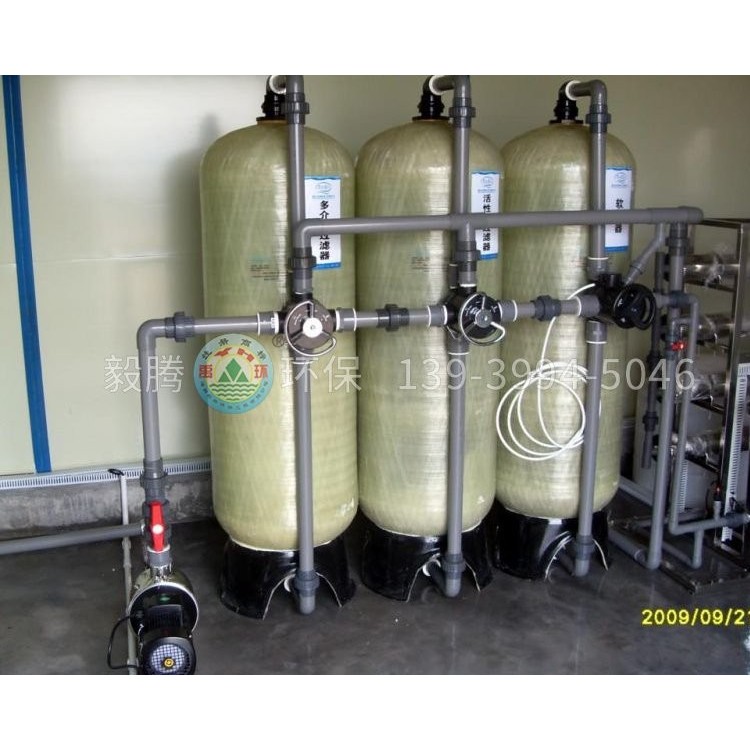
Softening water equipment, as the name implies, is used to reduce the hardness of water, primarily by removing calcium and magnesium ions. During the softening process, it does not decrease the total salt content in the water. It can be used for softening of make-up water in systems like air conditioning and for the treatment of potable water.
II. Working Principle:
The fully automatic sodium ion exchange unit utilizes ion exchange principles to remove scaling ions such as calcium and magnesium from water. When raw water containing hardness ions passes through the resin layer inside the exchanger, the calcium and magnesium ions in the water are exchanged with sodium ions adsorbed by the resin, causing the resin to adsorb the calcium and magnesium ions while the sodium ions enter the water. Thus, the water flowing out of the exchanger is softened, free of hardness.
Water hardness is primarily formed by calcium and magnesium, so generally, cation exchange resins (water softeners) are used to replace the Ca2+ and Mg2+ (main components forming scale) in the water. As the concentration of Ca2+ and Mg2+ in the resin increases, the efficiency of the resin in removing them gradually decreases.
Once the resin absorbs a certain amount of calcium and magnesium ions, it must be regenerated. The regeneration process involves flushing the resin layer with brine from the salt tank, displacing the hardness ions from the resin, which are then排出 with the regeneration waste liquid. The resin regains its softening and exchange functions.
The hardness of water is primarily formed by calcium and magnesium ions. The principle of sodium ion exchange softening is to pass the raw water through sodium-type cation exchange resins, allowing the hardness components Ca2+ and Mg2+ in the water to be exchanged with Na+ in the resin. This吸附 the Ca2+ and Mg2+ from the water, thereby softening it. If RNa represents the sodium-type resin, the exchange process is as follows:
2RNa + Ca2+ = R2Ca + 2Na+
2RNa + Mg2+ = R2Mg + 2Na+
Water, after passing through a sodium ion exchange unit, has its Ca+ and Mg+ ions replaced with Na+.
The operating process of a general control valve typically includes: operation, backwash, brine absorption, slow rinse, salt tank refilling, and normal rinse.
Section 3: Softened Water Quality Standards:
Hardness Unit mmol/L mN German Degree French Degree CaO (mg/L) CaCO3 (mg/L)
mmol/L 1 2 5.6077 10.0086 56.077 100.086
mN 0.5v 1 2.8039 5.0043 28.039 50.043
Germany Unit 0.17833 0.35665 1 1.7848 10.0000 17.848
France 0.09991 0.19983 0.5603 1 5.6029 10.0000
CaO(mg/L) 0.017833 0.025665 0.1000 0.17848 1 1.7848
CaCO3/(mg/L) 0.009991 0.01998 0.05603 0.1000 0.5603 1
Section 4: Softening Water Equipment Operation Process
Operation processes: working (also known as water production, etc.), anti-scaling, salt absorption (regeneration), slow flushing (exchange), and fast flushing. The processes of all soft water treatment systems are very similar, with some additional steps possibly due to specific process variations or control requirements. Any soft water treatment system based on sodium ion exchange is developed on the foundation of these five processes (with fully automatic systems including the process of salt water re-injection).
Reverse osmosis: After operating for a period, the equipment will intercept a significant amount of impurities brought by the raw water at the top of the resin. By removing these impurities, the ion exchange resin can be fully exposed, ensuring effective regeneration. The backwashing process involves water flowing into the resin from the bottom and out from the top, thereby flushing away the impurities collected at the top. This process typically takes 5-15 minutes.
Salt Absorption (Regeneration): The process of injecting brine into the resin tank. Traditional equipment uses a salt pump to inject the brine, while fully automatic equipment utilizes a dedicated built-in ejector to draw in the brine (as long as the incoming water has sufficient pressure). During actual operation, the regeneration effect of brine flowing slowly through the resin is better than simply soaking the resin in brine. Therefore, softening water equipment regenerates by allowing brine to flow slowly through the resin, which typically takes about 30 minutes, with the actual time affected by the amount of salt used.
Slow rinse (exchange): The process of slowly rinsing the resin clean of salt by passing raw water through it at the same flow rate after brine has flowed through the resin, is called slow rinse. Due to the fact that a large number of calcium and magnesium ions on the functional groups are still exchanged with sodium ions during this rinse process, based on actual experience, this is the main regeneration process. Therefore, many people refer to this process as exchange. This process typically lasts as long as the salt absorption time, which is about 30 minutes.
Rapid flush: To thoroughly rinse away residual salt, use a flow rate close to the actual working condition, flush the resin with raw water, and the final effluent of this process should be up to standard soft water. Generally, the rapid flush process takes 5-15 minutes.
V. Technical Specifications and Operating Requirements for Softening Water Equipment:
Inlet Water Pressure: 0.18-0.6 Mpa
Operating Temperature: 1-55℃ Source Water Hardness: <8 mmol/L
Operation Method: Automatic/Manual; Water Hardness: ≤0.03 mmol/L
Regenerant: NaCl, Regeneration Method: Countercurrent/Concurrent
Exchange Agent: 001*7 Strong Acidic Ion Exchange Resin
Control Method: Time/Flow; Working Voltage: 220V/50Hz
Section 6: Equipment Applications
Widely applicable for the softening of make-up water in systems such as steam boilers, hot water boilers, heat exchangers, evaporative condensers, air conditioners, and direct-fuel burners. It can also be used for the treatment of domestic water in hotels, restaurants, office buildings, apartments, and homes, as well as for softening water processing in industries such as food and beverage, brewing, laundry, dyeing, chemical, and pharmaceuticals.


















